On June 23, 2026, we released our largest YOSA content quality update to date.
We noticed a recurring problem: forcing users to lock in a title early in the workflow causes unnecessary friction. At the same time, high-performing search content requires measurable structural variety that standard text generation struggles to maintain.
This release addresses both issues directly, changing what YOSA creates and how you work with it.
Content quality improvements
We rebuilt the underlying rules that dictate how YOSA formats its output. Previously, output often defaulted to rigid text blocks that lacked the rhythm of hand-written copy.
Now, the AI output is noticeably more varied in its structure. We targeted the mechanics of document assembly to give you a publish-ready draft that requires less manual reformatting.
Structural balance and clarity
YOSA now correctly balances prose, lists, H3 headings, and supplementary elements based on the context of the section.
We also introduced a strict, clear separation between the TLDR section and the text summary.
This distinction prevents redundancy and improves structural clarity for the reader, ensuring the AI does not repeat the same takeaways at both ends of the document.
Expanded SERP analysis
Before drafting SEO guidelines, within the content generation, YOSA has always analyzed TOP10 Google results for your specified keywords. However, to this day, SERP data was mostly used to indentify search intents.
Through the series of experiments, we've decided that our proprietary analysis needs an expansion.
Now the system analyzes TOP10 Google results for your keywords in much greater detail. Not only to provide an LLM with what intents it needs to cover to rank, but also how to accualy create this coverage based on what Google really preferes to show.
This provides the AI with deeper context, ensuring the generated text is grounded in the actual search environment rather than generic assumptions.
Intent-driven SEO guidelines
The pre-generation SEO guidelines now focus strictly on user intent and specific content gaps. We built this to solve the problem of surface-level coverage.
The system now forces the writing agent to address exactly what searchers need to know, rather than trying to solve those issues on guidelines level and forcing certain content structure (as it was before).
The new prompt-based generation flow
We redesigned the YOSA generation flow. In the previous iteration, you had to define a title before doing anything else. We removed that constraint. The new workflow is native to the content workflow you already use, focusing entirely on the prompt.
Prompt-first creation
The primary field for content generation is now the prompt.
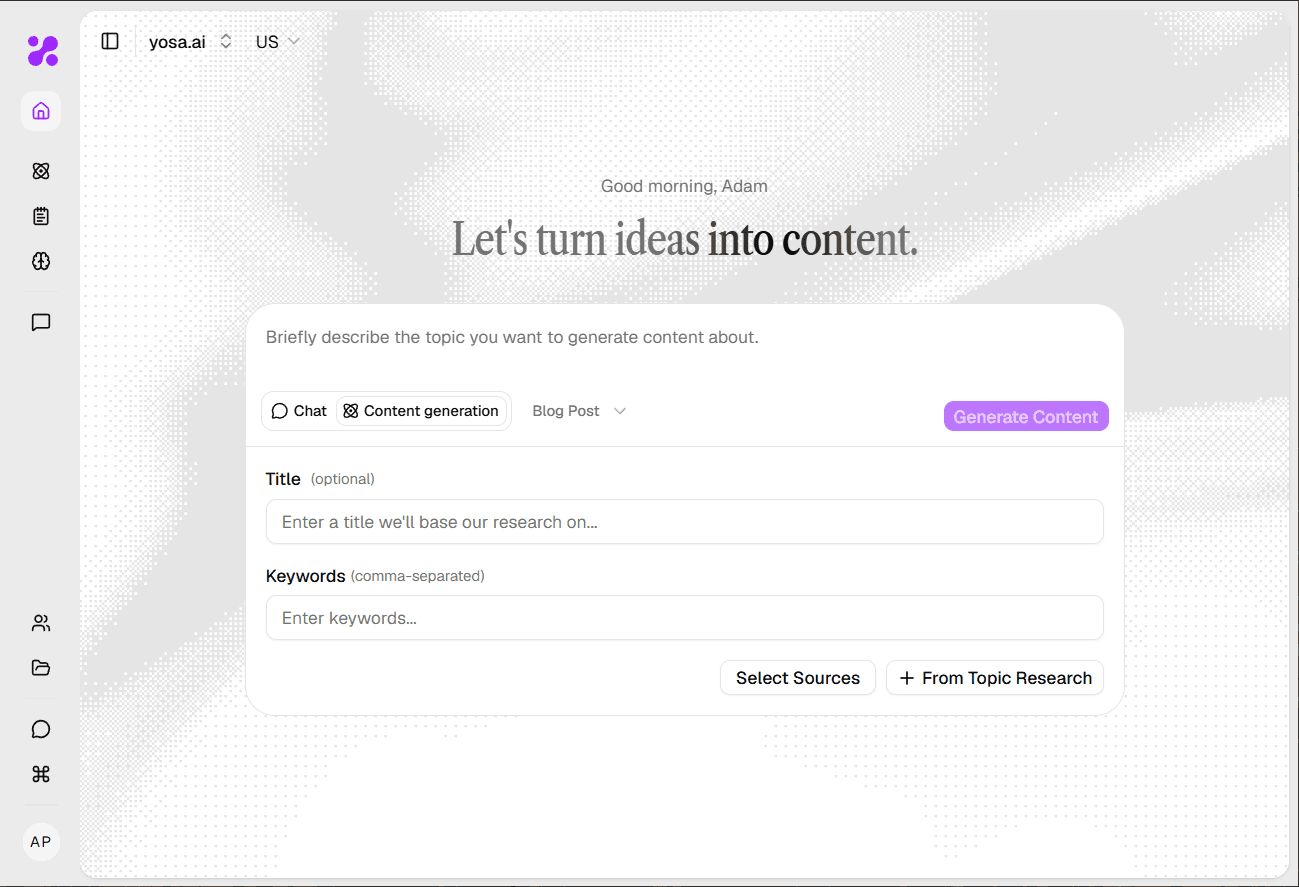
You briefly describe your goal, outline the topic, and specify your target audience. The title field is entirely optional. It serves only as a hint for SEO optimization and web research, not as a rigid constraint that locks in the rest of your process.
Knowledge Base source specification
You can now specify particular Knowledge Base sources when generating content.
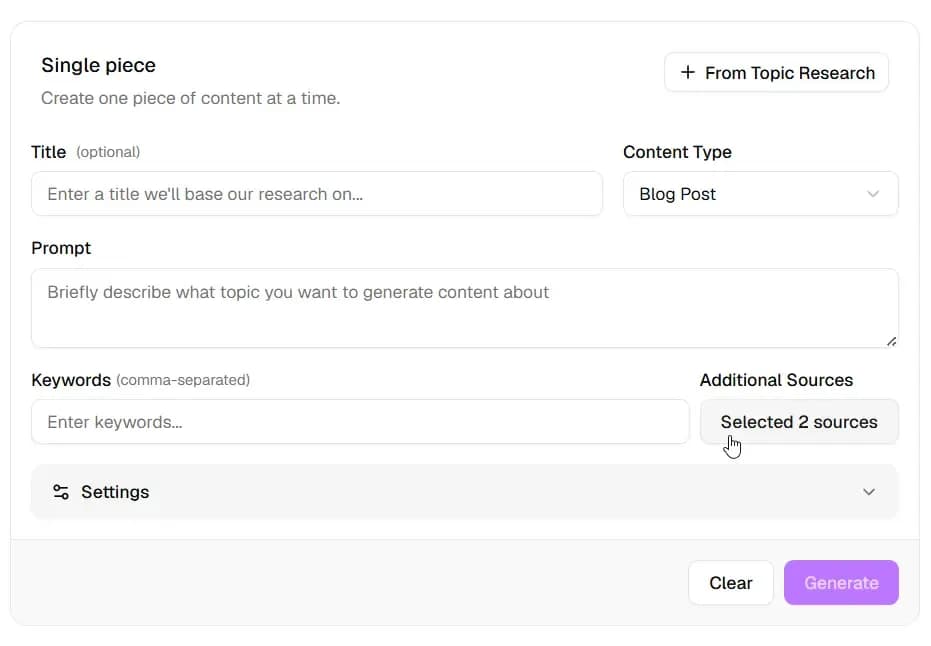
This gives you precision control over the knowledge layer. Instead of hoping the system pulls the right pages, you can define the exact boundaries. This grounds the AI in real information chosen explicitly by the user, ensuring higher specificity in the final draft.
Knowledge base and infrastructure fixes
We shipped a set of knowledge base features and infrastructure fixes to remove shared operational overhead.
We added a search bar directly in the URLs tab within the Knowledge Base, eliminating discoverability friction.
Knowledge Base also links now display the page's meta title, making it easier to verify what the crawler indexed.
Finally, we resolved a bug that caused occasional fact hallucinations even when the Knowledge Base was active. The system's grounding in your sources now works reliably.
Regenerate your Brand Voice
To get the new baseline of quality, you need to execute one manual step. Regenerate your Brand Voice before starting your next content generation.
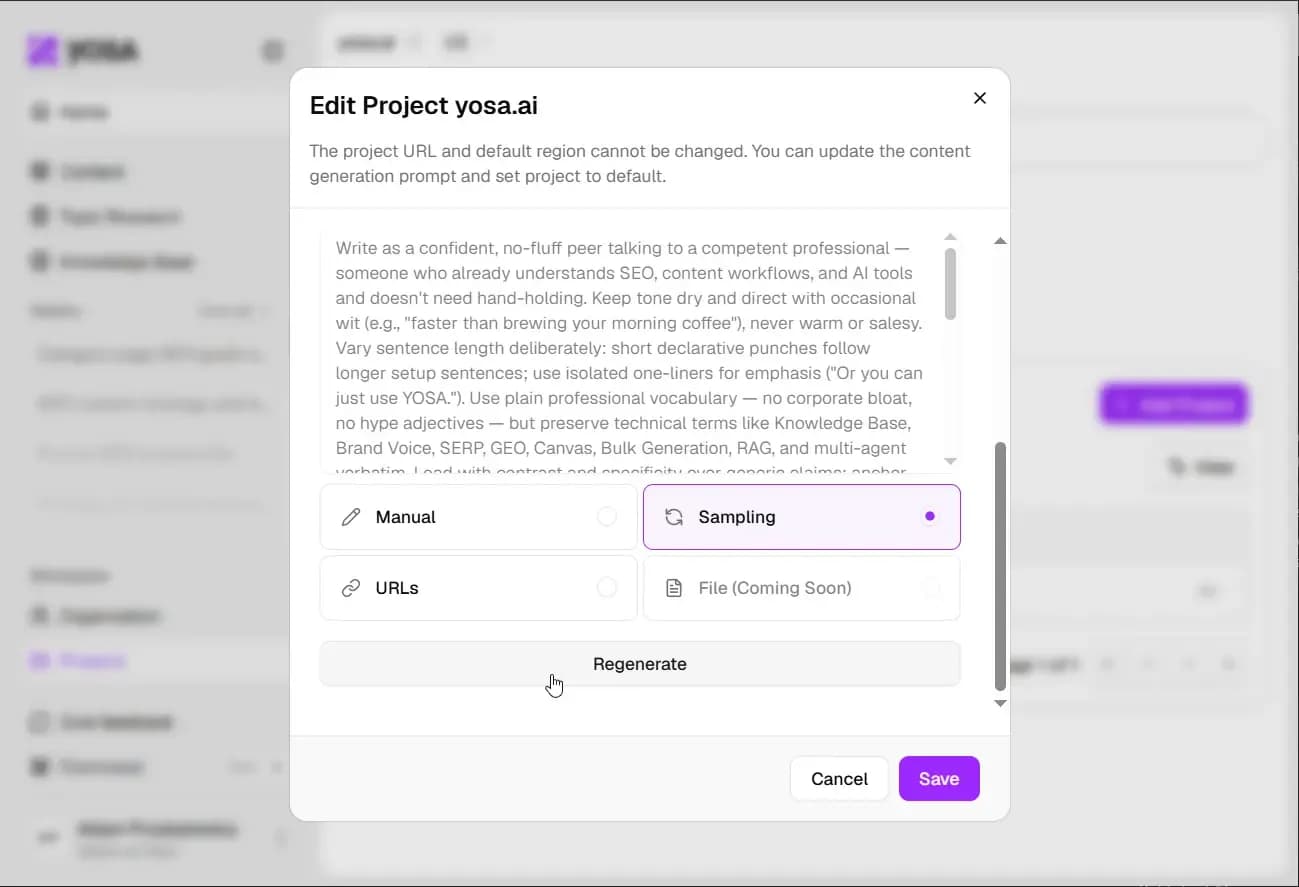
The brand voice update recognizes personal voice authentically and no longer forces the use of specific keywords into the style definition. This single action unlocks the new formatting capabilities and removes the forced robotic phrasing that occurred in highly constrained guidelines.
Next steps
The changes are live in your dashboard.
We recommend running a prompt-first generation today and comparing the output against your older drafts.
If you encounter issues or want to discuss how the updated pipeline fits your current workflow, reach out to us directly in the app.