Manual topic clustering is slow and easy to get wrong. AI changes the equation by automating the data mapping and reading semantic intent at a scale a human team can't match by hand.
This guide walks through how to move to an AI-powered content cluster strategy, with a concrete workflow for building pillars, avoiding cannibalization, and measuring whether any of it actually pays off.
The shift: how AI changes content clustering strategy
Every content team eventually hits the same wall: scaling production usually means either sacrificing quality or losing track of how the site actually fits together. AI helps on both fronts, because it lets you scale output while keeping semantic relevance intact, instead of forcing a trade-off between the two.
The difference comes down to how each approach groups topics. Traditional clustering leans on keyword string matching - you group phrases because they share words. AI clustering works from meaning instead. It uses vector embeddings to map search intent and entity relationships across a topic, so it reads context rather than just characters, and it can tell that two phrases belong together even when they don't look alike.
Think of the old approach as organizing a library strictly by the words in each book's title. An AI approach is closer to a librarian who understands how subjects relate to each other and shelves things based on what readers are actually trying to learn.
None of this removes the need for your judgment. AI does the computational heavy lifting - it parses the data and proposes a structure - but you're the one who applies editorial sense and business context to decide what the final map looks like. The tool is fast; it is not strategic on your behalf.
How AI identifies what your content clusters should be
Building semantic content clusters with AI takes a lot of the guesswork out of strategy. Instead of assuming topics belong together, you get a data-backed reason for grouping them.
Most modern tools rely on one of two methods. The first is SERP-based clustering, which groups keywords by the URLs that already rank for them: if Google consistently surfaces the same pages for two different queries, those queries usually belong in the same cluster. It's a strong signal, though worth treating as a signal rather than an absolute rule.
The second is semantic, or embedding-based, clustering. This uses NLP and vector embeddings (the same kind of language models that power tools like Claude or ChatGPT) to find deeper conceptual links. It can recognize that "drip campaigns" and "CRM integration" are parts of the same ecosystem even when they share no keywords at all.
Competitor reverse-engineering adds another useful layer. AI tools can scan competitor sitemaps and map how rivals organize a topic, which often exposes exactly where their clusters are thin - and where you have room to differentiate.
There's also intent clustering, which goes past raw search volume to group keywords by what the searcher actually wants: information, a comparison, or a solution to a specific problem. Done well, this keeps your cluster aligned with the full buyer journey instead of over-indexing on whatever has the biggest volume.
Step-by-step workflow for creating your first AI-powered content cluster
Building a real content architecture means shifting your mindset from "writing articles" to "engineering an ecosystem." The sequence below turns a single core topic into an authority hub. I'll use "content marketing for SaaS" as the running example so each step stays concrete.
1. Validate the pillar via intent analysis
Before committing resources, I check that the topic can actually support a full cluster. I search Google for "content marketing for SaaS" and look at what's on page one.
What I want to see: a mix of intent types - listicles, how-to guides, strategy posts, tool comparisons. Fragmented intent like this means no single page dominates, which is exactly the gap a pillar page fills by pulling those sub-topics into one authoritative hub.
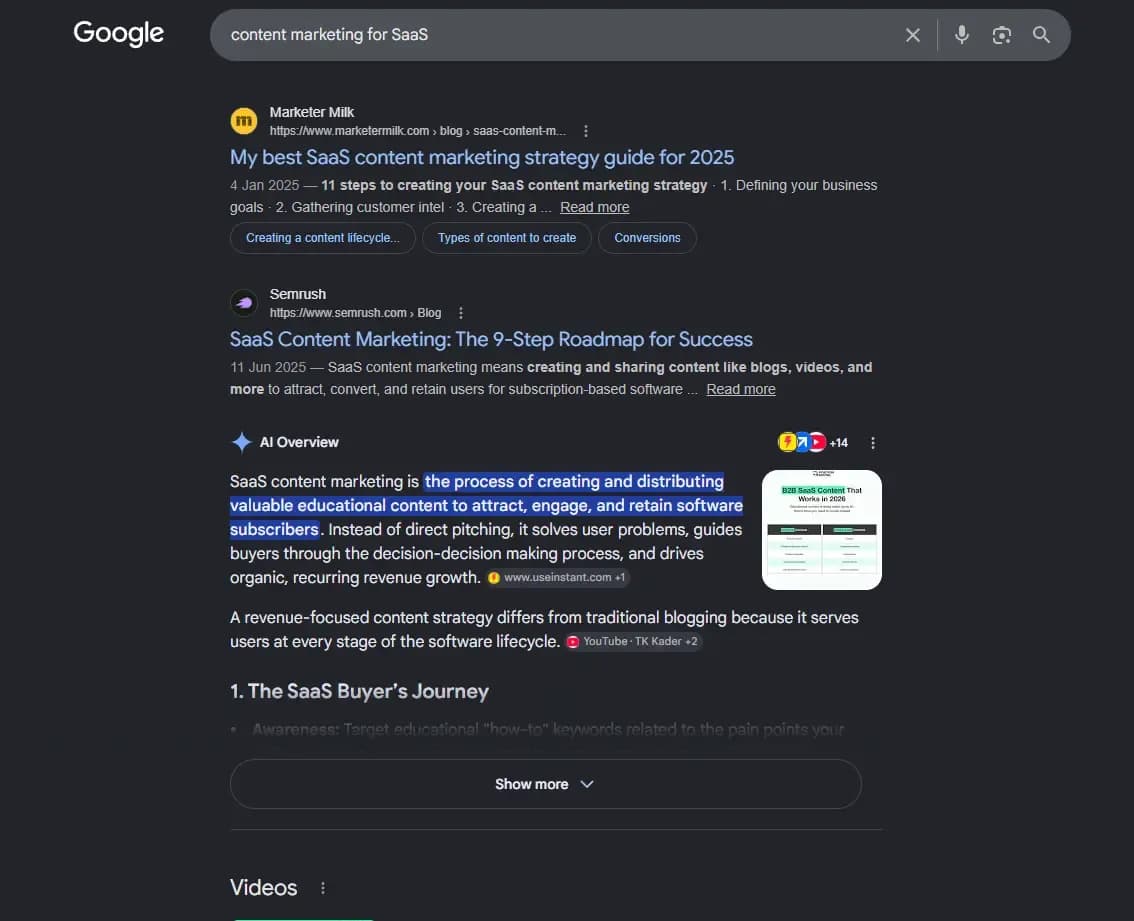
Quick check: Does the "People Also Ask" box show at least five to ten distinct questions? If yes, there's enough raw material for spokes. If PAA is thin or every page-one result looks basically the same, the topic is probably too narrow to anchor a full cluster - I'd go broader or reframe the pillar.
2. Run Topic Research - first pass (pillar → spokes)
This is where I'd normally spend hours pulling keyword CSVs and clustering them manually. Instead, I open YOSA Topic Research, enter "content marketing for SaaS," and get back a list of main topics - each with keywords already assigned.
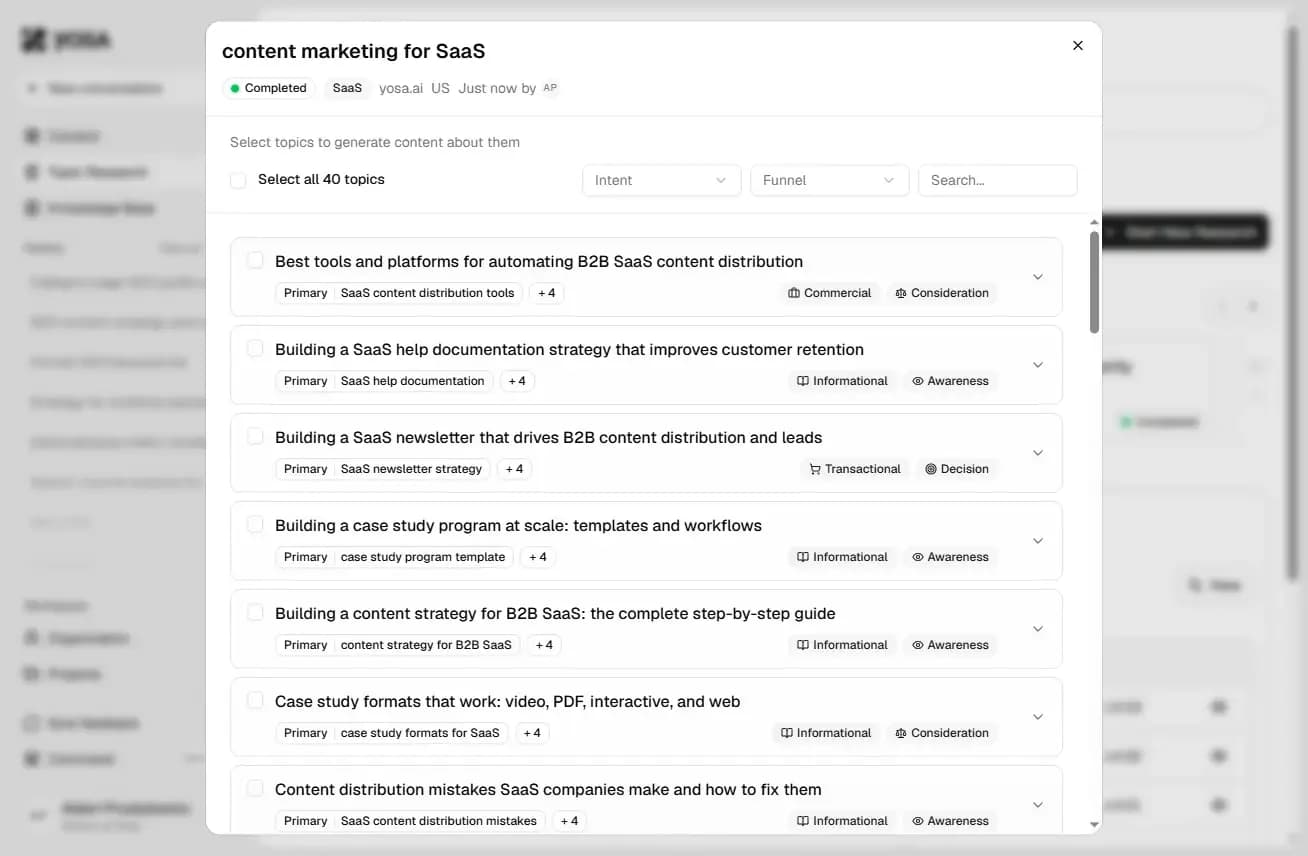
From that list I'm looking for themes that represent distinct reader intents and could each support their own page. For this pillar I'd pick something like:
- SaaS content strategy
- Content marketing ROI for SaaS
- SaaS blog best practices
- B2B SaaS SEO content
- SaaS product-led content
These become my spokes. I'm not taking everything the tool returns - I'm making editorial calls. I drop anything that doesn't fit my audience or overlaps too heavily with another spoke.
3. Run Topic Research - second pass (spokes → articles)
Now I take each spoke and run it through Topic Research again as a separate query. This is where the cluster gets its real depth.
I enter "SaaS content strategy" and get back a list of specific article topics with their keywords - these are the actual pages I'll build under that spoke.
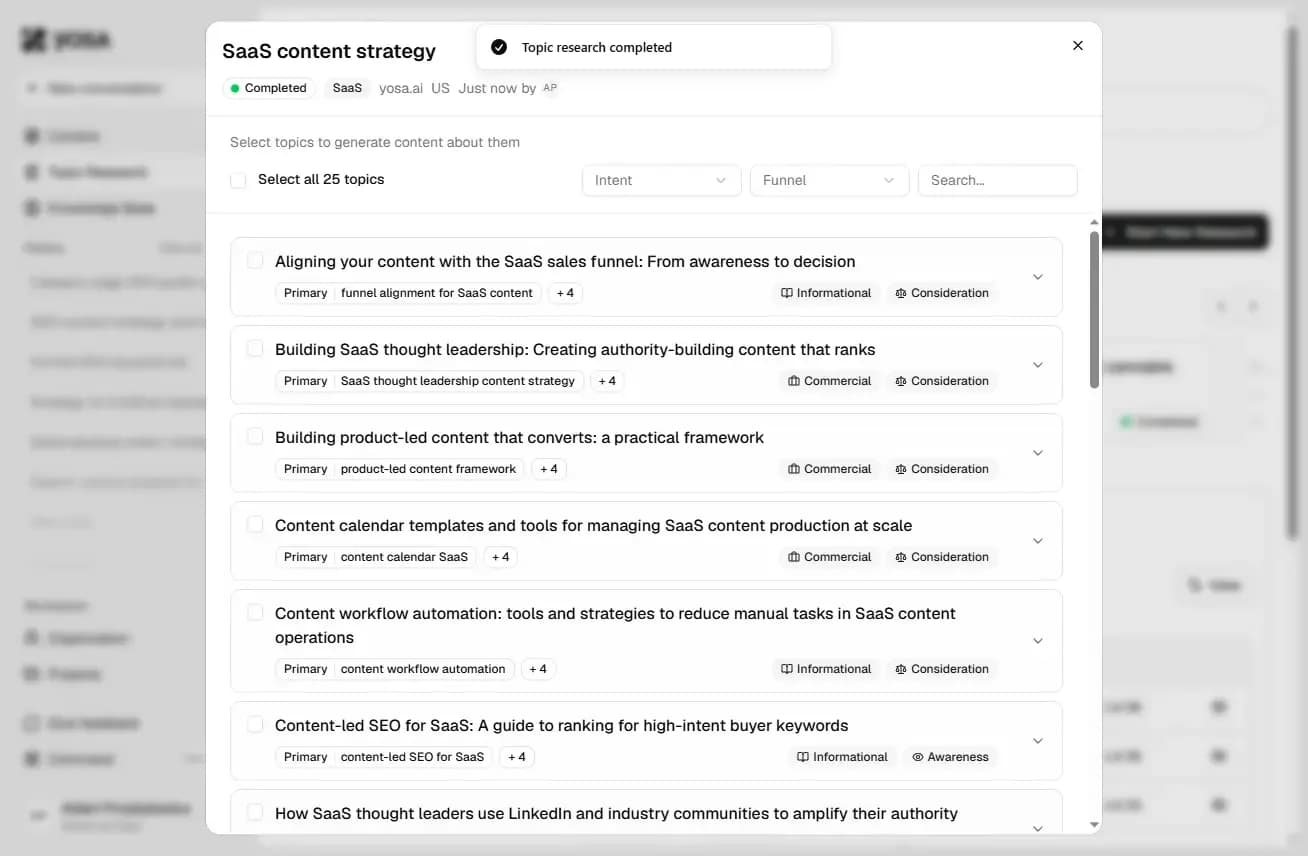
I repeat this for every spoke from step 2.
By the end of this pass I have a full two-level map:
- Pillar: Content marketing for SaaS
- Spoke: SaaS content strategy → 6-8 article topics
- Spoke: Content marketing ROI for SaaS → 6-8 article topics
- Spoke: SaaS blog best practices → 6-8 article topics
- (and so on)
There's no "save to cluster" button yet, so I copy everything into a spreadsheet or Notion as I go. It takes maybe ten minutes once you have the structure in your head.
4. Build the linking map
Before writing anything, I map the hub-and-spoke structure. A simple spreadsheet with four columns is enough:
Target keyword | Target URL | Parent pillar | Lateral spoke links |
Content marketing for SaaS | /content-marketing-saas | — | all spokes |
SaaS content strategy | /saas-content-strategy | /content-marketing-saas | SaaS blog best practices, B2B SaaS SEO |
Content marketing ROI for SaaS | /content-marketing-roi-saas | /content-marketing-saas | SaaS content strategy |
Every spoke links back to the pillar. The pillar links out to every spoke. Lateral links connect spokes where a reader on one page has obvious reasons to land on the other.
I fill this map before writing a single word. It keeps the cluster coherent as it scales and makes the link audit in step 5 trivial.
5. Generate with context, not just a prompt
Generic prompts produce generic content. Before I generate anything, I define the brief for each piece - audience persona, pain points, and the internal link instruction baked directly into the prompt.
YOSA's Multi-Agent Generation pulls this context from the Knowledge Base automatically, so I'm not re-pasting the same brand information into every brief. I set it once and it applies across the whole cluster.
6. Roll out in phases
I don't publish everything at once.
Phase 1: Pillar page plus the three highest-priority spokes. Submit all four URLs to Google Search Console immediately.
Phase 2: Remaining spokes over the next two to three weeks. Once everything is live, I run a quick internal link audit - any spoke with no inbound links gets fixed before it becomes an orphan page pulling no authority from the cluster.
A spoke properly linked into the hub benefits from the pillar's authority. An orphaned page earns nothing, even if the content itself is good.
Diagnosing and fixing keyword cannibalization
Cannibalization happens when several pages target the same intent. Without a central architecture, search engines can't tell which page you actually want to rank, so they split signals across all of them - and none ranks as well as one strong page would.
AI helps here by crawling your existing library, clustering it by intent, and flagging URLs that are quietly competing for the same position.
Once you can see the overlap, the fixes are straightforward. Consolidate the weakest pages and redirect them into the strongest. Where two pages are worth keeping, differentiate them by narrowing one to a more specific subtopic. And use a clear internal link hierarchy so it's obvious which page is the pillar.
The cheaper move, of course, is preventing the overlap in the first place. A tool that understands what's already on your site can build on existing content instead of generating a near-duplicate. This is exactly what the YOSA Knowledge Base is for - it gives the AI a memory of what you've already published, so it extends a cluster rather than quietly recreating a post from last year.
AI tools vs. manual strategy: finding the hybrid sweet spot
You can do all of this by hand - scrape SERPs, analyze intent, fact-check, structure everything yourself. It works, but it costs hours per article and doesn't scale past a certain point.
Automated clustering earns its place when you're auditing a large library with hundreds of posts, untangling an existing internal-link mess, or trying to scale without adding SEO headcount. That's where the time savings are real.
But automation has limits, and they matter. YMYL niches like health and finance need genuine human oversight, and competitive spaces still reward original thinking that a model can't manufacture on its own.
So the durable approach is hybrid: let AI handle research, data parsing, and first-draft outlining, and reserve human judgment for editorial direction, business priorities, and final polish. Neither half is optional.
Framework for choosing an AI content clustering tool
The AI SEO landscape roughly splits into three categories, and knowing which one you're buying saves a lot of disappointment:
- Pure clusterers (e.g. Keyword Insights): specialized tools for high-volume keyword grouping and mapping, usually built on shared SERP data. Strong at the mapping job specifically.
- Content optimizers (e.g. Surfer SEO's editor): focused on individual page performance and NLP-driven optimization rather than the cluster as a whole.
- All-in-one platforms (e.g. YOSA): systems that handle the whole pipeline, from discovery to a publishable draft, in one workspace.
The right pick depends on workflow fit, not feature count. A pure clusterer hands you an excellent map but stops there - you still have to take that map into a separate writing process. An all-in-one platform like YOSA trades some specialist mapping depth for the ability to go from cluster to draft without switching tools, which is what saves the hours when you're producing at volume. If your bottleneck is mapping, buy the specialist; if it's production, buy the platform.
Feature | Standalone clustering tools | Manual LLM prompting | End-to-end platforms (like YOSA) |
Clustering depth | Excellent, purpose-built | Variable, prompt-dependent | Good, breadth over depth |
Speed to draft | Fast mapping, separate writing step | Slow, lots of back-and-forth | Idea to draft in minutes |
Scalability | Strong for grouping, manual writing | Hard to manage in bulk | Built for bulk generation |
Quality control | N/A (mapping only) | Manual review required | Built-in multi-agent review, plus a human pass |
Workflow friction | Tool-switching required | Disjointed | Single workspace |
Protecting quality: keeping AI content human-centric
Using AI for clustering doesn't have to mean publishing generic filler. The quality is on you, not the model.
Start with firm editorial guidelines covering tone, depth, and factual rigor - and treat fact-checking as non-negotiable rather than a nice-to-have. A model will state something false just as confidently as something true.
Then add the things a model genuinely can't: original research, real customer examples, a point of view with some edge to it. The AI gives you a competent structure; the expertise that makes a page worth ranking comes from you. This is where YOSA's Canvas helps in practice - you leave comments on the draft and they become rewrites in place, so adding your expertise doesn't mean breaking your flow to rewrite from scratch.
Finally, review every internal link as a reader, not a bot. Links should feel natural and actually help someone get to the next thing they need, not just fire a semantic signal at a crawler.
Measuring the ROI of your AI topic clusters
If you can't measure it, you can't justify the investment - so decide up front what success looks like.
Track topical authority across the whole cluster rather than obsessing over single-keyword wobble; the metric that matters is the rising average position for the cluster as a group. Watch internal link engagement too, to see whether readers actually move through the pathways you built.
Then tie all of it back to business impact: the signups, demos, or conversions the cluster produces, and the time and cost you saved versus producing the same volume manually. That last number is usually the one that wins the budget argument.
One caveat worth setting with stakeholders early: organic results are gradual. A new cluster typically needs somewhere in the range of four to six months - sometimes longer in competitive niches - before it establishes real authority. Promising faster than that just sets up disappointment.
The future of content clusters in an AI-driven search environment
Clustering matters more now, not less. AI search and AI Overviews lean heavily on topical authority and well-linked webs of content to assemble their answers, which means a tidy, interconnected cluster is exactly the kind of thing they pull from.
The teams that win from here are the ones combining serious semantic research with authentic human expertise. Standalone articles don't carry a site the way they used to; interconnected ecosystems do.
So stop mapping topics by hand. Audit your existing library, run your first AI-assisted topic research, and ground your generation in both live web data and what you already know about your own site and customers. That's the whole idea behind YOSA - give it a try for free.